
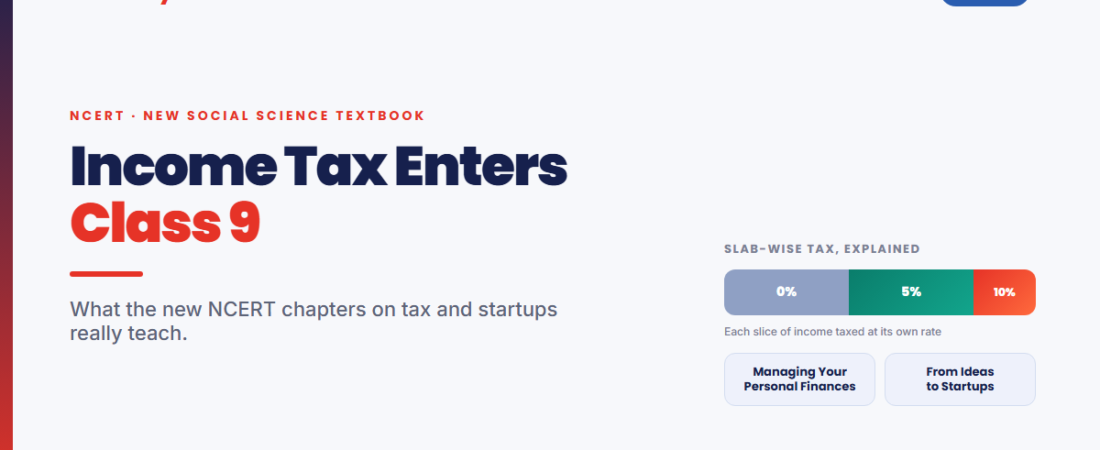
Income tax has just entered the Class 9 classroom. NCERT’s new Social Science textbook, Understanding Society: India and Beyond — Part 2 (released in late September 2026), has a chapter that teaches 14- and 15-year-olds how to calculate income tax, and another that tells the stories of Indian startups. Here’s what’s actually in these chapters, what’s deliberately left out, and what students and parents can do with it.
What’s new
The book follows NEP 2020 and the National Curriculum Framework for School Education (NCF-SE 2023), which push for practical, real-life learning earlier in school. Two chapters stand out:
Chapter 1: Managing Your Personal Finances
The chapter says that learning to manage money begins in childhood, and treats finance as a set of everyday choices. It builds on five “pillars” of personal finance:
The five pillars of personal finance
It also introduces the power of early investing and lists the main options students will meet later: fixed deposits, bonds, stocks (equity) and mutual funds. Borrowing responsibly and paying taxes complete the picture.
The income tax part
This is the headline. The chapter includes a table of tax slabs and walks students through the steps to calculate tax liability slab by slab, under the new income tax regime. It also frames paying tax honestly and on time as an important duty of every citizen — money that funds public infrastructure and schemes such as Ayushman Bharat PM-JAY.
How “slab-wise” tax works: an illustration
Many students assume that if your income crosses a slab, all of it is taxed at the higher rate. That’s wrong, and it’s exactly what the slab method teaches. Each portion of income is taxed only at its own slab’s rate. Here’s the method, using imaginary slabs to practise:
Practice example: imaginary income of ₹10 lakh
These slabs and rates are made up to explain the method. They are not the textbook’s table or the current official rates.
0%
5%
10%
| Slice of income | Rate | Tax on that slice |
|---|---|---|
| ₹0 – ₹4 lakh | 0% | ₹0 |
| ₹4 – ₹8 lakh (₹4 L) | 5% | ₹20,000 |
| ₹8 – ₹10 lakh (₹2 L) | 10% | ₹20,000 |
| Total tax | ₹40,000 | |
₹40,000 on ₹10 lakh is an effective rate of just 4% — far below the top slab’s 10%, because most of the income sits in the lower slabs.
To practise, ask your teacher for the actual slab table in the chapter, then repeat the same steps: split the income into slices, apply each slice’s rate, and add them up.
Chapter 2: From Ideas to Startups
This chapter tells the story of Indian entrepreneurship through real examples:
Two stories, one lesson: small starts, big outcomes
The textbook also gives a sense of scale: it says India had only around 350–400 startups about a decade ago, while the ecosystem has now grown to nearly 2.3 lakh enterprises — more than 500 times as many — and it mentions 120-plus unicorns. (These are the book’s own figures, as shared in NCERT’s media-coverage posts.)
What business contributes, according to the book
Notice how the two chapters connect: businesses create income, income is taxed, and taxes fund public services. That’s the loop the textbook wants students to see.
What students and parents can do
- Start a monthly budget with pocket money: track income, spending and savings for just one month. It’s the five pillars in miniature.
- Practise the slab method on a few imaginary incomes until it feels natural.
- Talk about taxes at home. Parents can use the chapter to explain where tax money goes.
- Find your local Lijjat. Ask: what small idea in your neighbourhood could grow? That’s the spirit of Chapter 2.
- Check your school’s syllabus to see whether these chapters will be tested in exams. We haven’t seen an official statement on that, so don’t assume.
In Class 9 this year?
See what else is new: our guide to CBSE Class 9 Advanced Maths & Science 2026-27.
Quick answers
Which NCERT book has the income tax chapter?
“Understanding Society: India and Beyond — Part 2,” the new Class 9 Social Science textbook, in the chapter “Managing Your Personal Finances.”
Does the textbook teach the old tax regime?
No. According to reports, the chapter teaches slab-wise calculation under the new tax regime and doesn’t mention the old regime.
Will students have to calculate tax in exams?
Not confirmed. The chapter includes tax-calculation steps, but whether and how it’s examined depends on your board and school syllabus. Check with your school.
What is Lijjat Papad’s story in the textbook?
Seven homemakers in Mumbai pooled ₹80 in 1959 to start a papad-making venture. It grew into a cooperative of about 45,000 members with a reported turnover of ₹1,600 crore by 2023.
Why is NCERT adding finance and startups to Class 9?
It follows NEP 2020 and NCF-SE 2023, which emphasise practical, real-life skills earlier in school, including financial literacy and an entrepreneurial mindset.