
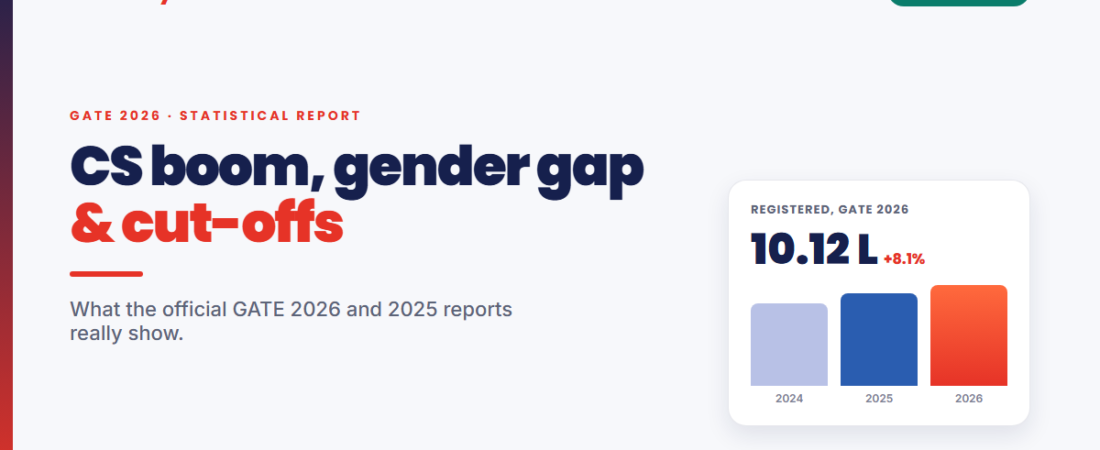
GATE 2026 set a record: 10,11,719 candidates registered. We read the official statistical reports of GATE 2026 (IIT Guwahati) and GATE 2025 (IIT Roorkee) paper by paper — and found three things the headline number hides.
Next up — GATE 2027 at a glance
1. A record 10 lakh registrations — up 8% in a year
From 9,36,019 registrations in 2025 to 10,11,719 in 2026 is an 8.1% rise. Those who actually sat the exam grew 6.7%, to 7,97,434, while the number who qualified grew 10.2%, to 1,56,318. Note one more quiet change: attendance slipped from 79.8% to 78.8%, so about one in five registrants still never turns up.
Registered vs appeared (lakh)
2025 and 2026: official statistical reports. *2024 as published in reports of the organisers’ data; I have not checked it against the PDF.
2. Computer Science is swallowing the exam
The CS paper drew 2,59,922 registrations in 2026, up 25% in one year, and now accounts for 25.7% of all registrations (it was 22.2% in 2025). Add Data Science & AI and the two computing papers are 35% of the whole exam, up from 30%. Meanwhile Civil, Mechanical and Electrical all shrank.
Change in registrations by paper, 2025 → 2026
Green = more candidates, red = fewer. Official paper-wise tables.
3. How hard was the cut-off, really?
The share of candidates who qualify barely moves overall (about 19%), but it moves a lot paper by paper. Look at the big ones:
Qualified ÷ appeared, by paper
Light bar = 2025, dark bar = 2026. Official counts.
Two things stand out. Electrical (EE) became easier to qualify in (17.6% → 20.9%), and Chemistry (CY) collapsed — 4,315 qualified in 2025, just 2,203 in 2026 (16.8% → 9.8%).
Why the cut-off moves
The General-category qualifying mark is the larger of 25 or (average + standard deviation) of the paper. In 2026, CS had an average of 18.51 and a standard deviation of 11.58 — add them and you get about 30.1, and the official cut-off is 30.0. In 2025, Mechanical had an average of 19.87 and a spread of 15.97: that is 35.8, exactly its cut-off. In 2026 Mechanical’s cut-off fell to 25.2.
| Paper (General) | 2025 cut-off | 2026 cut-off |
|---|---|---|
| Computer Science | 29.2 | 30.0 |
| Electronics (EC) | 25.0 | 26.4 |
| Electrical (EE) | 25.0 | 27.7 |
| Mechanical (ME) | 35.8 | 25.2 |
| Civil (CE) | 29.2 | 28.7 |
| Data Science & AI | 29.0 | 26.4 |
So the cut-off tells you how the paper went, not how competitive the year was. Qualifying makes your score valid for three years; admissions and jobs then look at your rank or percentile.
4. The gender gap is wide — even inside the same paper
Women were 38.6% of registrants in 2026 (up from 36.9% in 2025), but only 26.6% of qualifiers. Overall, 13.7% of women who appeared qualified, against 23.2% of men.
You can’t explain that gap by branch choice alone: it stays large inside CS and EC, which are the two biggest engineering papers. The report counts candidates; it doesn’t say why. That is a question for colleges, coaching and mentoring — and it’s the one we most want to see move in 2027.
Where it all began: GATE in 1983
The first GATE was held on Saturday, 26 February 1983, conducted by the five IITs then existing (Bombay, Delhi, Kanpur, Kharagpur, Madras) together with IISc Bangalore, following the Nayudamma Review Committee on postgraduate engineering education. We found the original 1983 information brochure. Here is how far the exam has come:
| GATE 1983 | GATE 2026 | |
|---|---|---|
| Who ran it | 5 IITs + IISc, under a joint committee | One organising IIT each year (IIT Guwahati) |
| Papers | Paper I: General Engineering Sciences (2 hours, 40%) + Paper II: one discipline (3 hours, 60%) | One 100-mark paper: 15 marks General Aptitude + 85 marks subject |
| Disciplines | 17 engineering + 8 science disciplines, including Computer Science and Engineering | 30 papers (36 paper codes), from Data Science & AI to Humanities |
| Applying | Send a postal order of ₹5 and a stamped envelope to get the form (issued 1–24 Dec 1982), then post it back with a ₹45 demand draft | Online application portal |
| Fee relief | SC/ST candidates exempt from the ₹45 fee | Concessions as per the current information brochure |
| In the hall | Bring your own slide rule and instrument box; electronic calculators allowed | Virtual calculator on screen |
| Why it mattered | Qualifying was needed for M.Tech at the six institutes; only GATE-qualified admits got the 18-month scholarship | M.Tech, PhD and PSU recruitment |
What this means for GATE 2027
- Expect more competition in computing. CS and DA are heading for more than a third of the whole exam. A “safe” rank there needs more depth than a year ago.
- Don’t read last year’s cut-off as a target. It moves with the paper (ME dropped by ten marks in a year). Aim above the band.
- Check your branch’s own numbers. Qualification rates swing a lot in smaller papers; one paper’s year tells you little about another’s.
- Look past the headline. A 19.6% pass rate hides a 13.7% vs 23.2% split between women and men, and the same gap shows up inside CS and EC.
More on this exam: GATE 2027 application form and fees, eligibility, pattern and preparation strategy, and the DigiLocker rule change.
FAQ
How many candidates registered for GATE 2026?
10,11,719 registered and 7,97,434 appeared, according to the official GATE 2026 statistical report. 1,56,318 qualified, which is 19.60% of those who appeared.
Which is the most popular GATE paper?
Computer Science. In 2026 it had 2,59,922 registrations (about 26% of the exam), up from 2,07,851 in 2025.
How is the GATE qualifying mark decided?
The General-category qualifying mark is the larger of 25 and the paper’s average plus standard deviation. That is why it differs by paper and year.
When is GATE 2027?
6–7, 13–14 and 20–21 February 2027, with results on 19 March 2027. All dates are liable to change.
Preparing for GATE 2027?
FirstVidya builds the deep, concept-first foundation that survives any year’s difficulty swing — aimed at top ranks, not just the cut-off.