
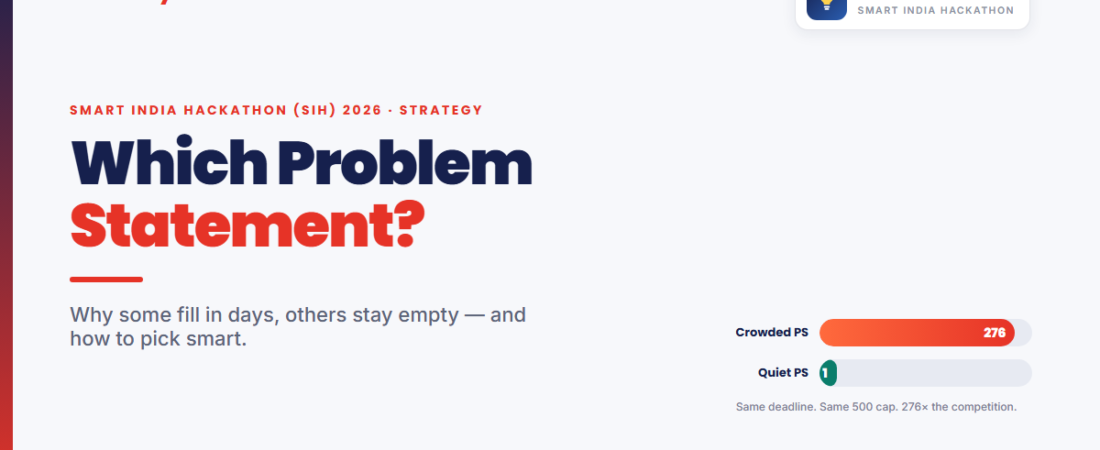
One SIH 2026 problem statement already has 276 teams registered against it. Another, from a top ministry, has 1. Same portal, same 30 September deadline, same 500-team cap. So what actually decides where students pile in — and where they don’t? It’s rarely the quality of the problem. It’s psychology — and once you see the pattern, you can use it.
Fill counts are a snapshot from the SIH 2026 portal in mid-September 2026 (58 Hardware + 182 Software PS). They keep rising daily — the pattern, not the exact number, is what matters.
01The recognition effect
Students don’t read all 240 problem statements before choosing. They scan for names they already trust — Ministry of Ayush, ISRO, DRDO, a state government — and stop scrolling once something sounds familiar and “official enough.” The crowded PS are almost always the recognisable, high-empathy ones:
The crowded problem statements (teams registered / 500)
Recognisable ministries + relatable problems = instant pile-on.
02The jargon filter
The moment a title contains “cryptographic,” “forensics,” “kinetic modelling,” or “mine subsidence,” most student teams assume it needs specialist knowledge they don’t have — even when the actual build is a fairly standard web or ML pipeline.
03Herd behaviour
Once a PS crosses ~50 teams, it starts looking “validated” — students assume it must be a good problem because everyone else picked it. That perception pulls in even more teams, and the gap widens on its own. It’s the same mechanic behind viral restaurant queues: crowds attract crowds, regardless of what’s being served.
04Skill-fit bias
Most college teams default to whatever they already know how to build — so familiar-shaped problems flood while unfamiliar-shaped ones sit untouched, regardless of which is actually easier to execute well.
| Team type | Where they flock |
|---|---|
| Web / app-first teams | Portals, dashboards, citizen-facing apps |
| AI / ML-first teams | Anything titled “AI-Powered” or “Smart” |
| Hardware-light teams | Avoid IoT / embedded PS entirely |
05The quiet zone — where the real opportunity is
Here’s the part most teams miss: a low submission count doesn’t mean a bad problem. It often means a well-scoped, genuinely solvable one that simply hasn’t been noticed yet.
The quiet problem statements (teams registered / 500)
Clear scope, real ministries, near-zero competition — genuinely under-the-radar.
06How to read the fill count
The fill-rate gap isn’t random noise — it’s predictable, which makes it usable. Before you lock your choice, put the PS into one of three zones:
The one-line strategy
Don’t chase the crowd, and don’t fear the empty ones. Find a problem your team can genuinely build, sitting in that 5–30 range — provable, but not swamped. That single decision, made this week, can matter more than a weekend of extra coding.
New to SIH?
Start with our complete SIH 2026 guide — the full timeline, the 17 themes, team rules, and how winning teams actually think.
Quick answers
Does a high submission count mean a better problem?
No. High counts mostly reflect recognisable ministries, relatable framing and herd behaviour — not problem quality. Many excellent, well-scoped problems sit nearly empty.
Is it risky to pick a PS with only 1–2 teams?
Only if it needs skills your team lacks. If you can genuinely build it, low competition is an advantage — fewer near-identical pitches for the jury to compare you against.
What’s the ideal fill range to target?
Roughly 5–30 submissions: enough that the problem is clearly solvable, few enough that a strong execution still stands out.
Do these fill numbers keep changing?
Yes — they rise daily as teams register, and each PS locks at 500. Treat the figures here as a mid-September snapshot; the behaviour pattern is what stays true.
Where do I see the live counts?
On the official SIH portal’s problem-statements page, in the “Submitted Idea(s) Count” column. Check it before your team finalises a choice.