
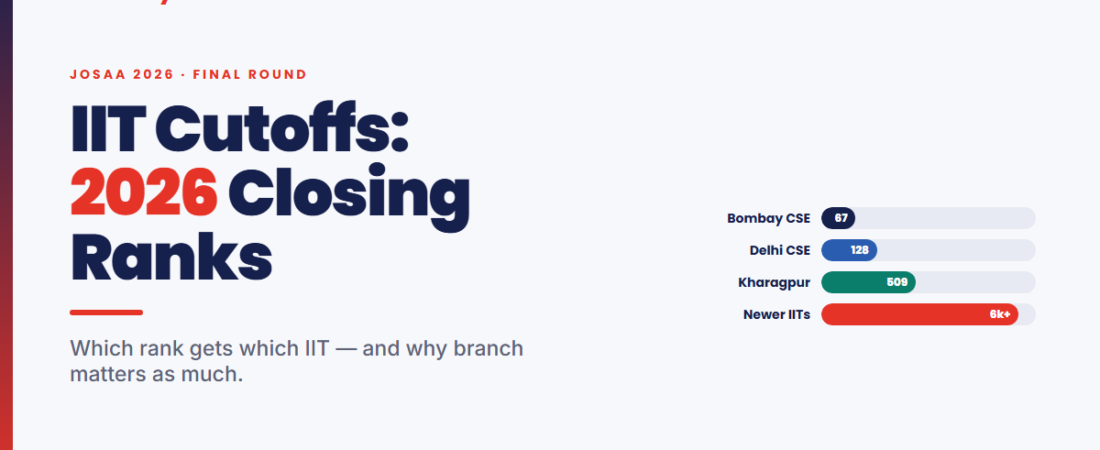
The JoSAA 2026 counselling is over, and the final numbers are in. If you want a seat in IIT Bombay Computer Science, you needed an All-India Rank of about 67 — out of 1.8 lakh who qualified JEE Advanced. Here is what the 2026 closing ranks actually reveal about which rank gets which IIT, and why your branch choice matters as much as the institute.
First, what “closing rank” actually means
In JoSAA counselling, every branch at every IIT publishes two numbers per round:
- Opening rank — the best (lowest) rank allotted that seat.
- Closing rank — the last rank that got in. This is the real cutoff: if your rank is better than the closing rank, you had a genuine shot.
All the numbers below are closing ranks for the Open category, gender-neutral pool, from the final round of JoSAA 2026. Reserved-category and female-pool cutoffs are different (and generally higher rank numbers).
The CSE ladder: which rank gets which IIT
Computer Science is the most-chased branch, so its closing ranks are the sharpest signal of an IIT’s pecking order. Here is the 2026 ladder for the old IITs:
IIT CSE closing ranks — JoSAA 2026 (Open, gender-neutral)
Lower rank = harder to get in. Bar length scaled to rank.
The takeaway is stark: the top five IITs all close CSE inside roughly the top 500 ranks. Then there is a long tail — the newer IITs (Bhilai, Dharwad, Jammu, Palakkad and others) close CSE anywhere from a few thousand to over 6,000. Same three letters, very different entry bar.
Your branch matters as much as your IIT
Here is what most rank predictors gloss over: within a single IIT, the gap between CSE and the core branches is enormous. Take IIT Bombay — the same institute, four different worlds:
IIT Bombay closing ranks by branch (approx, Open GN)
Approximate closing ranks — core branches close thousands of ranks later than CSE.
So a rank of ~2,000 gets you nowhere near CSE at IIT Bombay — but it comfortably lands you Mechanical at the very same IIT. This is the single most useful thing to understand before you lock your JoSAA choice order.
The quiet story of 2026: the top barely moved
JoSAA runs multiple rounds so seats can shuffle as students upgrade. But in 2026, the premium CSE seats hardly budged:
IIT Bombay CSE closing rank across the five rounds (2026)
The top seats froze — a move of only a handful of ranks from Round 1 to Round 5.
What your rank realistically gets you (2026)
How to actually use these numbers
- Compare your rank to last year’s closing rank, not the opening rank. The closing rank is your real threshold.
- Fill many choices, in true preference order. JoSAA gives you the best seat you’re eligible for — extra choices never hurt, they only protect you.
- Decide early: dream IIT vs dream branch. A great branch at a slightly lower IIT often beats a weak branch at a top one.
- Don’t bank on later rounds for top seats — as 2026 showed, they don’t open up.
Want the bigger picture?
See how these cutoffs have shifted over time in our 5-year IIT cutoff analysis — and why qualifying is only the start.
Quick answers
Was Round 5 really the last JoSAA round for IITs in 2026?
Yes. IIT allotment closed at Round 5 — there was no Round 6 for IITs. Any remaining IIT-system vacancies move to the CSAB special rounds, not JoSAA.
What is the difference between opening and closing rank?
Opening rank is the best rank allotted a seat; closing rank is the last (highest-numbered) rank that got in. The closing rank is the effective cutoff you should compare your own rank against.
Are these ranks for all categories?
No — the figures here are for the Open category, gender-neutral pool. OBC-NCL, SC, ST, EWS and female-pool closing ranks are different, generally at higher rank numbers.
Does a closing rank guarantee I’ll get the same seat next year?
No. Closing ranks shift year to year with the number of applicants and seat matrix. Use them as a strong guide, not a guarantee — keep a buffer.
My rank is ~2,000 — can I get CSE at IIT Bombay?
Not for CSE at IIT Bombay (which closes near 67). But ~2,000 is well within range for Mechanical at IIT Bombay, or CSE at several newer IITs. This is why branch-vs-institute planning matters.