
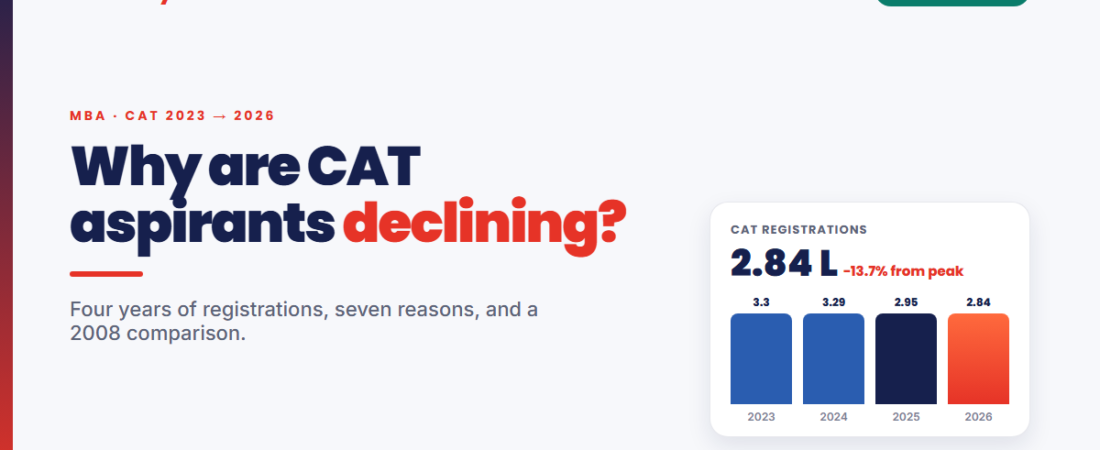
CAT registrations stood at about 3.3 lakh in 2023 and 3.29 lakh in 2024. Then they fell to 2.95 lakh in 2025, and IIM Indore now reports 2.84 lakh for 2026. That is about 45,000 fewer aspirants than the peak. Is the MBA losing its shine, or is something subtler going on?
We covered the headline number in our CAT 2026 registrations report. This post goes one level deeper and asks why. One honest note up front: neither IIM Indore nor any other official body has published a reason for the decline. What follows is a ranked set of explanations, and we label each one by how well the evidence supports it.
The numbers at a glance
CAT registrations: the last 4 years
Candidates registered, in lakh (1 lakh = 100,000).
Source: IIM-published figures as reported for each CAT. CAT 2023 is commonly given as around 3.3 lakh.
First, a reality check on the size of the fall
“Declining” is accurate, but “collapsing” is not. Registrations held at about 3.3 lakh for two years, then slid by roughly 45,000 over the next two. The real story is a peak and a settling: after a sharp jump in 2023, the numbers are drifting back toward a more serious-aspirant baseline. Zoom out to 20 years and the shape looks surprisingly familiar, as the section below shows.
There is also a measurement wrinkle. According to one coaching portal’s tally, around 3.27 lakh CAT user IDs were generated this year, but only 2.84 lakh candidates completed registration. IDs generated fell about 4.4% from last year, so the dip shows up at the very start of the funnel too, not just at the final step.
Seven reasons aspirants are staying away
1The hangover from the 2023 surge
Many analysts describe the jump to 3.3 lakh in 2023 as abnormal. Some of those extra registrations were casual or exploratory, people who filled a form “just to see.” When the novelty faded, the less committed half of that cohort did not come back. Part of what looks like decline is simply a return to the underlying serious-aspirant base.
2A job market that rewards staying put
Explanations of the 2025 dip repeatedly point to improved corporate hiring and rising salaries. When a graduate or a two-year professional is getting raises, quitting to spend two years and a large sum on an MBA is a harder sell. The same pattern was seen in earlier cycles: GMAC’s 2022 survey linked a drop in Indian business-school applications to a hot hiring market.
3The ROI maths is getting tougher
Flagship IIM programmes now cost roughly ₹20 lakh and above in fees, and aspirants can read placement reports as closely as any recruiter. The picture is split. Top campuses look healthy: IIM Bangalore’s recent final-placement median was about ₹32.6 lakh, and IIM Mumbai reported an average of ₹47.5 lakh in 2026, going by their placement reports as covered by Careers360 and Career Launcher. But Careers360’s 2026 comparison found median salaries fell at six of nine newer IIMs, and reports on the 2025 season noted dips in average packages at campuses such as IIM Kozhikode and IIM Indore. When only the top tier clearly pays back, fewer people want to risk the long tail.
4The decision is moving earlier: IPM after Class 12
Integrated Programmes in Management (five-year BBA+MBA) are available at a growing list of IIMs, and the entry route is IPMAT or JIPMAT right after school, not CAT. Coaching providers describe rising demand for this path. Every student who commits to an integrated programme at 17 is a student who never becomes a CAT aspirant at 22. We have not seen data that measures this effect directly, so treat it as a likely contributor, not a proven one.
5More ways to get an MBA without CAT
XAT, NMAT, SNAP, CMAT and others have always competed with CAT, and online and part-time MBAs (including executive programmes from global universities) keep growing. Working professionals in particular can now get a credential without leaving their job, which removes one of CAT’s biggest audiences.
6Fewer people are completing the form
The gap between IDs generated and successful registrations (3.27 lakh vs 2.84 lakh) shows that the process filters out people who start but do not finish. Registration fees also went up for 2026, according to one coaching portal’s summary. Even small friction, like fee payment and category-certificate uploads, trims the final count.
7Anxiety about what AI does to entry-level jobs
This one is our reading, not a finding. IIM Ahmedabad’s 2026 season saw strong consulting and BFSI hiring with technology recruitment described as slower, and the wider tech sector has had layoffs and pay freezes. Some prospective students may be asking whether a two-year MBA is the safest response to an uncertain job market. No survey we found tests this directly.
Zoom out: 20 years of CAT, and a familiar shape
Extend the chart back to 2005 and 2026 stops looking like a one-off. The last time registrations were this high was 2008, the final year CAT was a pen-and-paper exam. About 2.9 lakh people registered that year and about 2.76 lakh sat the test. Today’s 2.84 lakh registrations are within about 2% of that mark.
CAT registrations, 2005–2026 (lakh)
Registered candidates. Figures follow MBAUniverse’s year-wise table, cross-checked against other portals; small differences exist between sources (for example 2018 is 2.40 or 2.41 lakh).
What happened after the 2008 peak
Registrations fell about 17% in 2009 (to 2.41 lakh), the year CAT moved to a computer-based test, and another 15% in 2010 (to 2.04 lakh). That is roughly 30% below the peak in two years. They then hovered around 2 lakh for about five years, and CAT did not exceed its 2008 level again until the 2023 surge.
The reasons are debated. One widely repeated explanation is the switch to a computer-based format, which brought technical and logistical problems at first. A PaGaLGuY retrospective points instead to 2008 being an artificially high year before the global recession hit MBA hiring, with a flood of mid-tier MBAs weakening the payback. These explanations are not mutually exclusive.
Same four-year window, side by side
To compare the two episodes fairly, the chart below lines up each peak year (2008 and 2023) and follows registrations for the next three years. Both lines are indexed so the peak equals 100, which makes the size of each fall directly comparable.
Registrations as % of peak: 2008 → 2011 vs 2023 → 2026
Labels show registrations in lakh and the change from the peak year. Source figures as in the chart above.
How to read it. After 2008 the line dropped steeply and then went flat at about 70% of the peak. After 2023 it has fallen later and more gently, to about 86% of the peak, and 2026 is the latest point, so this line is still unfinished. The comparison is also not perfectly like-for-like: the 2009 fall coincided with the switch to a computer-based exam and the global recession, while today’s fall has different drivers (the job market, fees and alternatives, as discussed above).
| CAT 2008 | CAT 2026 | |
|---|---|---|
| Registered | ~2.90 lakh | 2.84 lakh |
| Appeared | ~2.76 lakh | ~2.5 lakh expected (our estimate) |
| Exam format | Last pen-and-paper CAT | Computer-based, three slots |
| What came before | Registrations up about 31% in 2007 and 16% in 2008 | Registrations up about 29% in 2023, then flat in 2024 |
| What came next | About 30% fall in two years | About 14% fall so far, over two years |
What the long view tells us
- Surges tend to be followed by a settling. Both the 2007 jump (about 31%) and the 2023 jump (about 29%) were followed by declines. This is a pattern in two cases, not a law.
- So far the current slide is gentler. The 2008–2010 fall was about 30%; 2023–2026 is about 14%.
- 2.84 lakh is still high by the standards of 2010–2022. In that whole period, registrations stayed between 1.95 and 2.55 lakh. Every year of that range was below today’s number.
- The history cannot tell us what 2027 holds. Last time the baseline reset to about 2 lakh and stayed there. Whether this time repeats that, or settles higher, depends on the job market and MBA payback discussed above.
What this means if you are preparing for CAT 2026
| Question | Short answer |
|---|---|
| Will the exam be easier? | Not reliably. Percentile is relative to people who actually sit the exam, and those are the serious ones. |
| How many will appear? | Roughly 2.5 lakh if the usual 87–89% turn-up holds (2.58 lakh appeared in 2025 out of 2.95 lakh registered). That is our estimate, not an official forecast. |
| What moves the 99th percentile most? | The paper itself. Analysts note the 99th-percentile mark has swung by many marks between years, which dwarfs the effect of an 11,000-person dip. |
| Exam date? | 29 November 2026, in three slots, conducted by IIM Indore. |
Get free exam guides and data explainers from FirstVidya. Read the numbers behind the headline in our CAT 2026 registrations report.